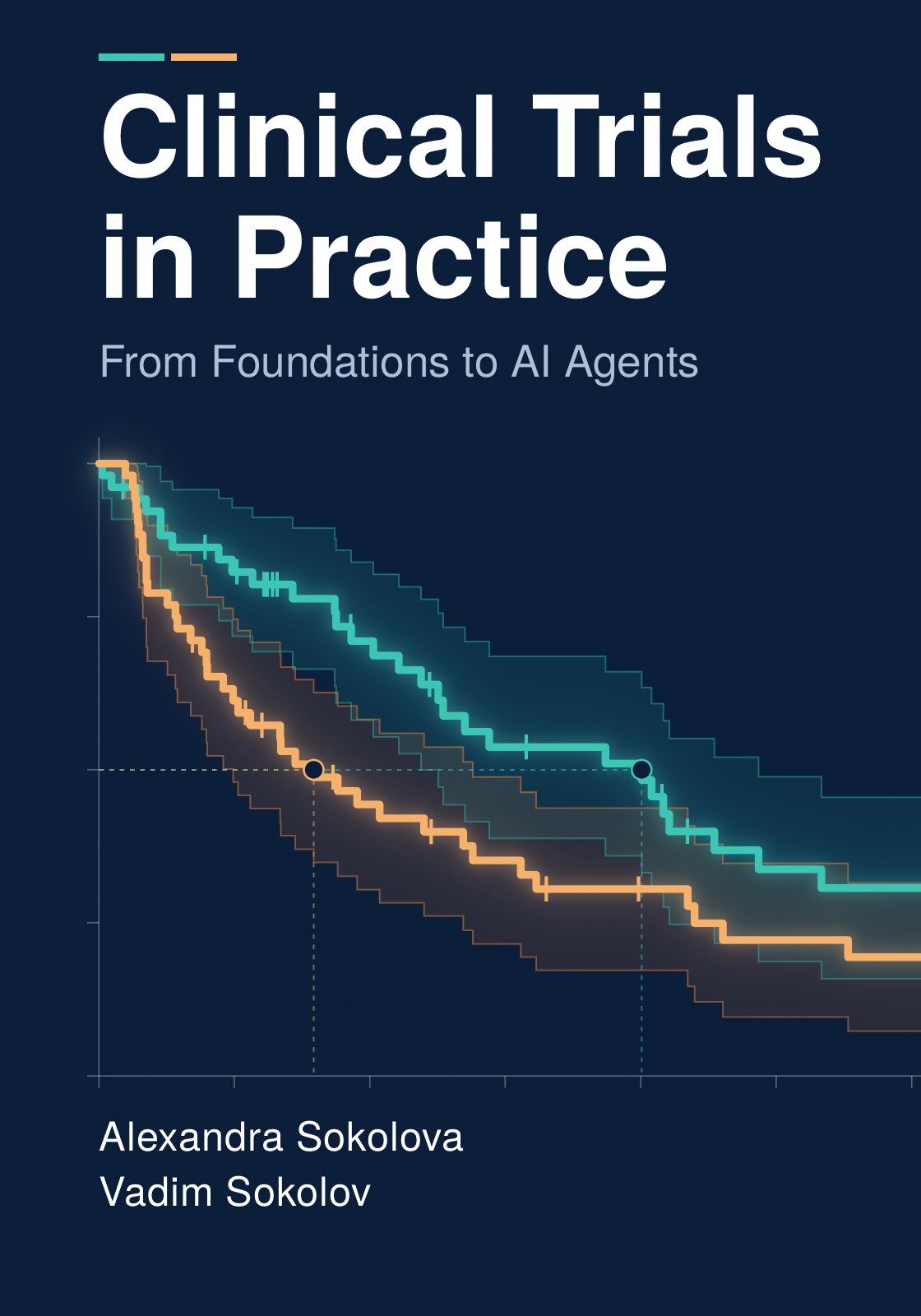
Clinical Trials in Practice From Foundations to AI Agents
By Alexandra Sokolova and Vadim Sokolov.



Description
On an open highway you can pass every other car and go fast. A clinical trial is like downtown driving. The pace is set by the traffic around you: regulators, sites, patients, and the protocol itself.
This book explains how that traffic moves and how to work with it. It follows a trial from the first idea to the regulatory submission and gives Phase III the most room, because that is where approval is won or lost. Statistics, operations and technology are taught side by side, because a design choice in the protocol becomes a task at the site, a field in the database and a document an inspector will ask to see.
Some of the questions it answers: When does a study need an IND, and what does an investigator take on by becoming the sponsor of one? How do you size a trial, plan interim analyses, and decide whether an adaptive or Bayesian design is worth the extra planning? When can real world evidence or an external control arm support a regulatory decision? Why does a site that predicts 30 patients sometimes enroll 3, and how should a sponsor read feasibility data? What does an academic multi-site trial need from its coordinating center, and what does a site new to research, rural or urban, usually lack? What does risk-based monitoring change about a monitor’s work? What has to be in the trial master file when the inspector arrives?
The chapters run in the order a development program does. They begin with how clinical research took its present shape, from the Elixir Sulfanilamide deaths of 1937 to ICH E6(R3) Good Clinical Practice, and with the ethics of research with human subjects. They follow a compound through development economics and Phases I to IV. The Phase III part covers statistical methods, adaptive and Bayesian trial design with platform trials such as I-SPY 2 and REMAP-CAP, study design and protocol complexity, randomization and blinding, endpoints and estimands, site selection, patient recruitment and retention, logistics and project management, data management and EDC, clinical monitoring, safety reporting, essential documents and the trial master file, and the IT systems underneath. The last chapters cover closeout, the clinical study report, and regulatory submission, including expedited pathways and FDA inspections.
The chapter on AI agents treats an agent as one more computerized system that must survive an inspection. It sets out what FDA and EMA guidance allows today, such as TMF filing, query generation and eligibility prescreening as decision support, and what it does not allow, such as replacing the investigator’s judgment. It describes how structured, machine-readable protocols (ICH M11, CDISC USDM) connect the protocol to data collection, and it says plainly where no measured evidence exists yet. Every use it describes needs validation, an audit trail and a named person accountable for each decision.
It is written for medical directors, study managers and monitors; for investigators and site coordinators, including those running their own investigator-initiated trials; for statisticians who want to see how a design plays out in practice; and for students and informatics and AI engineers who need to know how regulated research works before they build tools for it.
How to cite
Sokolova and Sokolov (2026), Clinical Trials in Practice: From Foundations to AI Agents, edition 1, https://doi.org/10.5281/zenodo.23537080.
@book{sokolovasokolov2026clinical_trials_in_practice,
  author = {Sokolova, Alexandra and Sokolov, Vadim},
  title = {{Clinical Trials in Practice: From Foundations to AI Agents}},
  year = {2026},
  publisher = {Independently published},
  doi = {10.5281/zenodo.23537080},
  url = {https://vsokolov.org/books/clinical_trials_in_practice/}
}
License: Text, figures and PDF: CC BY 4.0. Code: MIT.
This page is generated from the book’s repository (main). The numbers and pages are those of the PDF, version 1.1.1.