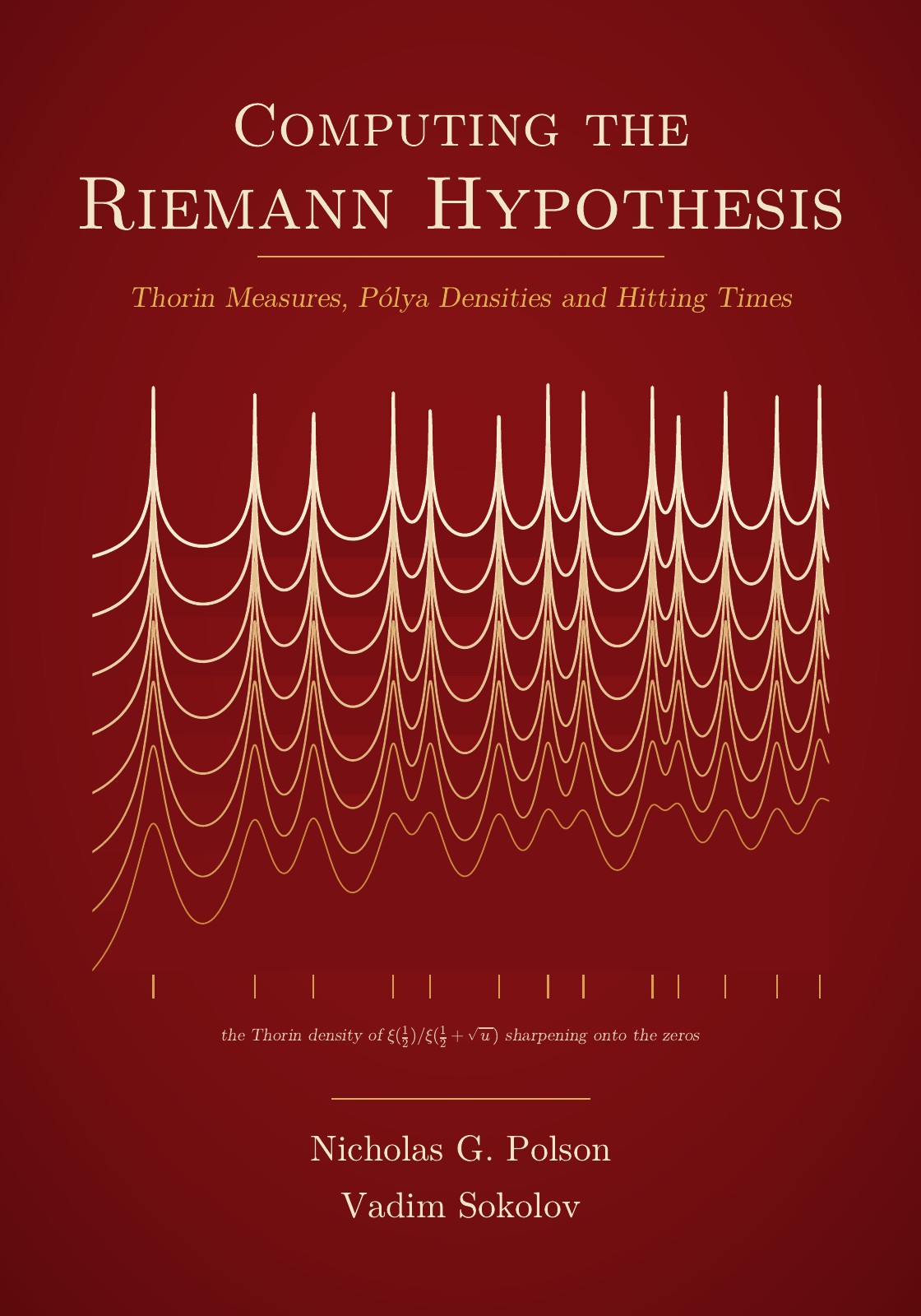
Computing the Riemann Hypothesis Thorin Measures, Pólya Densities and Hitting Times
By Nicholas G. Polson and Vadim Sokolov.



Description
The Riemann Hypothesis can be restated as the positivity of a measure, the Thorin measure of a ratio of values of Riemann’s Xi function. This book computes that measure from Pólya’s integral for Xi, without primes or a list of zeros, in certified ball arithmetic, and asks what such computations can and cannot teach about the zeros.
A certified zero off the critical line would refute the hypothesis, but no finite computation can prove it. From the zeros verified up to height 3 × 10^12 the book certifies that the derivatives of the heat trace have the predicted signs up to order 1.16 × 10^25, and proves that such finite positivity tests cannot settle it: a perturbation of Xi with the same zeros below a large height, and zeros off the line above it, passes them. No proof of the hypothesis is claimed.
New results: the reciprocal Xi function at x to the power p is hyperbolically completely monotone exactly when the absolute value of p is at most one minus twice the largest zero angle over pi; at the basepoint one the Thorin density is certified smallest at the origin, so the shifted clock is a stable variable plus a generalized gamma convolution; between the basepoints one half and one the shifted clocks are almost generalized gamma convolutions, unconditionally; the clock of Pólya’s Bessel function is the hitting time of an explicit diffusion; adjacent real zeros of a polynomial cannot meet under the backward heat flow before an explicit time; and the Pólya law lies within 2 × 10^-6 in total variation of the ferromagnetic laws of Lee and Yang, a distance that is zero exactly under the hypothesis.
An appendix lists the scripts and data files behind the tables and figures, which are in the book’s repository https://github.com/VadimSokolov/computing_rh.
How to cite
Polson and Sokolov (2026), Computing the Riemann Hypothesis: Thorin Measures, Pólya Densities and Hitting Times, edition 1, https://doi.org/10.5281/zenodo.23400373.
@book{polsonsokolov2026computing_rh,
  author = {Polson, Nicholas G. and Sokolov, Vadim},
  title = {{Computing the Riemann Hypothesis: Thorin Measures, Pólya Densities and Hitting Times}},
  year = {2026},
  publisher = {Independently published},
  doi = {10.5281/zenodo.23400373},
  url = {https://vsokolov.org/books/computing_rh/}
}
Main results
- Bosch type theorem for the reciprocal Xi function (Theorem 4.3.6, page 94): The reciprocal Xi function composed with the power x to the p is HCM exactly when the absolute value of p is at most one minus twice the largest zero angle over pi, so RH is the extreme case p equal to one.
- Derivative signs of the heat trace up to order 1.16 x 10^25 (Theorem 5.1.10, page 136): From the verification of RH to height 3 times 10^12, every derivative of the heat trace alternates in sign, equivalently the Williamson measures are positive, up to order 1.16 times 10^25, with the numerical inequalities of the proof certified in ball arithmetic.
- Biane form lower bound for the collision time of zeros under the backward heat flow (Theorem 8.4.8, page 279): While all zeros of a real polynomial stay real and simple, a gap between two adjacent zeros cannot close under the backward heat flow before the time one over the minimum of Laguerre’s quantity over the gap, a bound at least as strong as the one from the critical point and attained by z squared minus a squared.
- Clock of Pólya’s Bessel function as a hitting time of an explicit diffusion (Theorem 8.7.10, page 357): The index side clock of Pólya’s Bessel function, the GGC with Thorin atoms at the squares of the positive zeros of nu maps to K_{i nu}(2 pi), is the clock of a hitting time of a level by an explicit diffusion, planar Brownian motion killed at rate one half and Doob transformed by K_0.
- Minimum of the Thorin density at the origin and stable summand at the basepoint one (Proposition 9.1.4, page 385): With no hypothesis on the zeros, certified with the first 1800 zeros in ball arithmetic and explicit zero counts above height 2000, the Thorin density of the shifted clock at the basepoint one is smallest only at the origin, so the clock is the sum of an independent positive stable one half variable and a generalized gamma convolution.
- Almost GGC theorem for the shifted clocks (Theorem 11.4.2, page 541): With no hypothesis, for every basepoint between one half and one the Cauchy kernels of the zeros to the right of the basepoint carry a vanishing fraction of the mass of the kernels of the other zeros, with a power saving from zero density estimates.
- Total variation distance from the Pólya law to ferromagnetic laws is below two millionths, with no hypothesis (Proposition 13.4.6, page 639): With no hypothesis the total variation distance from the Pólya law to the ferromagnetic laws is below 1.932 × 10^-6 by a certified computation in ball arithmetic and below 1.266 × 10^-4 by an explicit construction, and it is zero exactly when the Riemann Hypothesis holds.
- Threshold theorem along the flow for the shifted clocks of the heat flow function (Theorem 15.2.3, page 700): For every time \(t\ge0\) and basepoint \(\alpha\ge\frac12\), the shifted clock of the heat flow function \(\xi_t\) is the Laplace transform of a generalized gamma convolution exactly when no zero of \(\xi_t\) has real part above \(\alpha\), and its Thorin measure is then an explicit sum of Cauchy kernels and atoms over the zeros.
- Phase diagram theorem, de Bruijn’s strip theorem in Thorin form (Theorem 15.3.2, page 702): The set of points \((t,\alpha)\) where the shifted clock of the heat flow function is a generalized gamma convolution is carried along parabolas by the flow (de Bruijn’s strip theorem in Thorin form), the de Bruijn Newman constant is the minimum of \(t+2(\alpha-\frac12)^2\) over it, and RH holds exactly when the corner \((0,\frac12)\) belongs to it.
All 278 results of the book (203 proved, 11 conditional, 61 open, 3 counterexample) are on the page Results by chapter, each with its statement, status and number.
License: Text, figures and PDF: CC BY 4.0. Code: MIT.
This page is generated from the book’s repository (main). The numbers and pages are those of the PDF, version 1.1.0.